

The Prevention Principle and Notice Provisions in FIDIC Contracts: A Recap
This article examines the conflict between the prevention principle and FIDIC notice provisions. Traditionally, employers cannot enforce obligations causing delays, but modern contracts demand strict notice compliance. Recent cases favor enforcing notice regimes, even for employer-caused delays, sparking fairness concerns.

Design risk under FIDIC contracts: Navigating responsibilities and liabilities
Introduction The allocation of design risk is an important consideration for parties to construction contracts. Misunderstanding or misallocation of design risk can lead to significant time and cost overruns and ultimately to expensive disputes. This article explores how design risk is allocated under the FIDIC forms of contract and suggests practical strategies by which parties may mitigate design risk. What is design risk and why is its allocation important? Design risk refers to the responsibility for, and potential liability associated with the adequacy, accuracy, and completeness of the design for the works. It is about which party bears the consequences

Developments in Collaborative Contracting
Introduction The construction market is increasingly seeking out new ways to collaborate, to enable the participants to increase value and quality across projects. There are a variety of contract options designed to meet the needs of the contracting parties including the PPC2000 Project Partnering Contract 2000, the NEC4 Alliance Contract, TAC-1 Term Alliance Contract, and the FAC-1 Framework Alliance Contract. FIDIC[1] are developing their own form of collaborative contract which is due to be released in 2026. What is Collaboration? Professor Mosey D. (2021) has described collaborative contracting as: "… a set of processes and relationships through which teams can

India is Building Bridges: Cross-Border Collaboration on Construction Disputes
India is cautiously opening its doors to global expertise. The Bar Council of India has announced amendments that allow foreign lawyers and law firms to practice in India within the prescribed scope. These changes have significant implications for international arbitration in the construction sector, where disputes often involve complex contracts and parties from different jurisdictions. Introduction In May 2025, the Bar Council of India enforced amendments[1] to its rules that allow foreign lawyers to represent clients in India within areas of foreign law, international law, and international arbitration matters; a development welcomed by the Law Society of England and Wales
Howard Kennedy plays key role in launch of the International Construction Arbitrators Association (ICAA)
ICAA, founded by Edward Corbett, offers a global list of specialist arbitrators for international construction disputes. Modeled on the LMAA, it promotes expertise, diversity, and next-generation professionals. The list is available at www.intcaa.org.

New International Construction Brochure
Our leading international construction team specialise in the avoidance and resolution of disputes arising in the construction and engineering sector. In addition, we advise on procurement, drafting and negotiating contracts. To find out more, download the brochure.

Introducing the Spring Series of FIDIC Contracts Seminars
Howard Kennedy’s International Construction team are getting together with Cornerstone Seminars to put on a series of 8 weekly online seminars relating to FIDIC Contracts. Click to find out more.
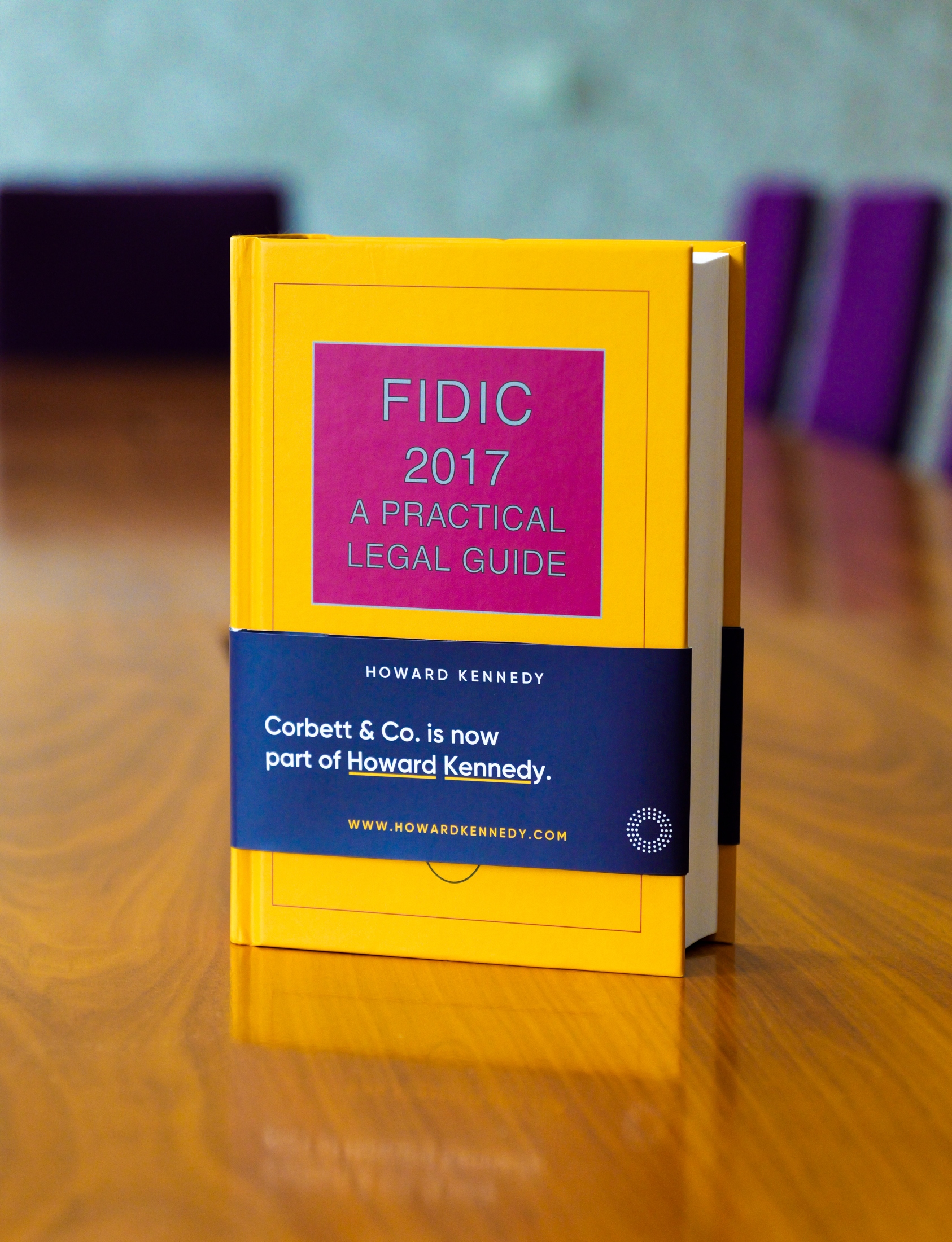
Celebrating Five Years of FIDIC 2017: A Practical Legal Guide
November 2025 marks five years since the International Construction team at Howard Kennedy LLP published FIDIC 2017: A Practical Legal Guide, which is praised for clarity, depth, and practical utility, becoming an essential resource for administering complex FIDIC contracts and avoiding disputes.

Claims resolution procedures in construction contracts
Claims are common in construction projects, but success depends on effective management and preventing disputes. Claims may arise from contract terms or breaches, while governing law affects interpretation and remedies. This article shows how FIDIC forms guide resolution, highlighting key differences between 1999 and 2017 editions.

Seminar: Introduction to International Arbitration in Construction & Engineering Disputes
Jo Clarke, in a webinar hosted by MBL Seminars, gives an introduction to international arbitration when used to resolve international construction and engineering disputes. It will include practical and tactical perspectives.

SOLD OUT: Autumn Series of FIDIC Contracts Seminars
Howard Kennedy’s International Construction team are getting together with Cornerstone Seminars to put on a series of 8 weekly online seminars relating to FIDIC Contracts. Click to find out more.

Red and Green should never be seen. Is it time for a rethink?
Prolongation costs are difficult to calculate, and the time and effort required may be disproportionate to the sum recovered. The Green Book contains a new mechanism for calculating prolongation costs. Could or should this mechanism be incorporated into the Red Book?

Who is writing your arbitration awards?
Arbitration can be expensive and time-consuming. Concerns have arisen over the quality of awards due to excessive copying, delegation, and AI use, potentially damaging credibility and trust in arbitration. Are standards slipping?

Desafíos de los contratos FIDIC en español
Challenges of FIDIC Contracts in Spanish
Languages, by nature, are not perfect reflections of each other, and this means that the Spanish translations of the FIDIC contracts differ (sometimes with serious consequences) from their originals in English. This article is available in Spanish and English.

Bridging the green – is FIDIC moving forward sustainably in 2025?
Introduction There is an intensifying need (we say rightly) for the construction industry, globally, to address climate change in line with global climate objectives. According to the UN, the buildings and construction sector is the largest emitter of greenhouse gas, accounting for about 37% of global emissions[1]. Focus was previously on decreasing operational carbon emissions[2] but is now also on mitigating embodied carbon emissions[3]. This requires collaboration of all stakeholders and innovative strategies to decarbonise building materials if the ambitious 2016 Paris Agreement's[4] net zero target is to be achieved by 2050. Most developed countries have taken a proactive and
International Construction Brochure
Our international construction team specializes in dispute avoidance and resolution, procurement, and contract negotiation. We cover major sectors globally, advising employers, engineers, and contractors on large projects, with cross-border expertise and collaboration on local law issues. Click below to read our brochure.

FIDIC Seminars – Contracts
Day 1 Time Session 08.30 Registration 09.00 Overview of the FIDIC contracts 09.45 Which form to use? -Allocation of functions, particularly design -Allocation of risks -Methods of payment -Measurement 10.30 Coffee 10.45 Workshop 1 – choosing the right procurement method 11.45 The roles of the Employer and the Engineer -Employer’s financial arrangements -Duties and authority of the Employer and the Engineer -The changed role of the Engineer -Determinations 12.30 Lunch 13.30 The risk of delay -The Contractor’s obligation -Extensions of time for completion -Acceleration -Penalties for delay 14.15 Risk, responsibility, liability and insurance -Principles of risk and risk allocation -Responsibility

FIDIC contracts – Introduction to the FIDIC Green Book 2021
This Practice Note is an introduction to the FIDIC Green Book 2021 (the Short Form of Contract). It is not a fully detailed clause-by-clause commentary. A LexisNexis article produced in partnership with Victoria Tyson of Howard Kennedy.

Design Obligations in Design-Build Contracts – Recurring Issues
Standard form design and build contracts vary in contractor design obligations, requiring fitness for purpose or reasonable skill and care. Revisions can lead to unclear, contradictory obligations, causing recurring issues highlighted in recent cases, which Contractors and Employers should be aware of.